Dispatches
Veteran Bitcoin Core Contributor, Peter Todd, Joins MARA Foundation as Lead Maintainer of Slipstream
Long-standing Bitcoin Core contributor, Peter Todd, joins MARA Foundation as Lead Maintainer of MARA’s Slipstream.
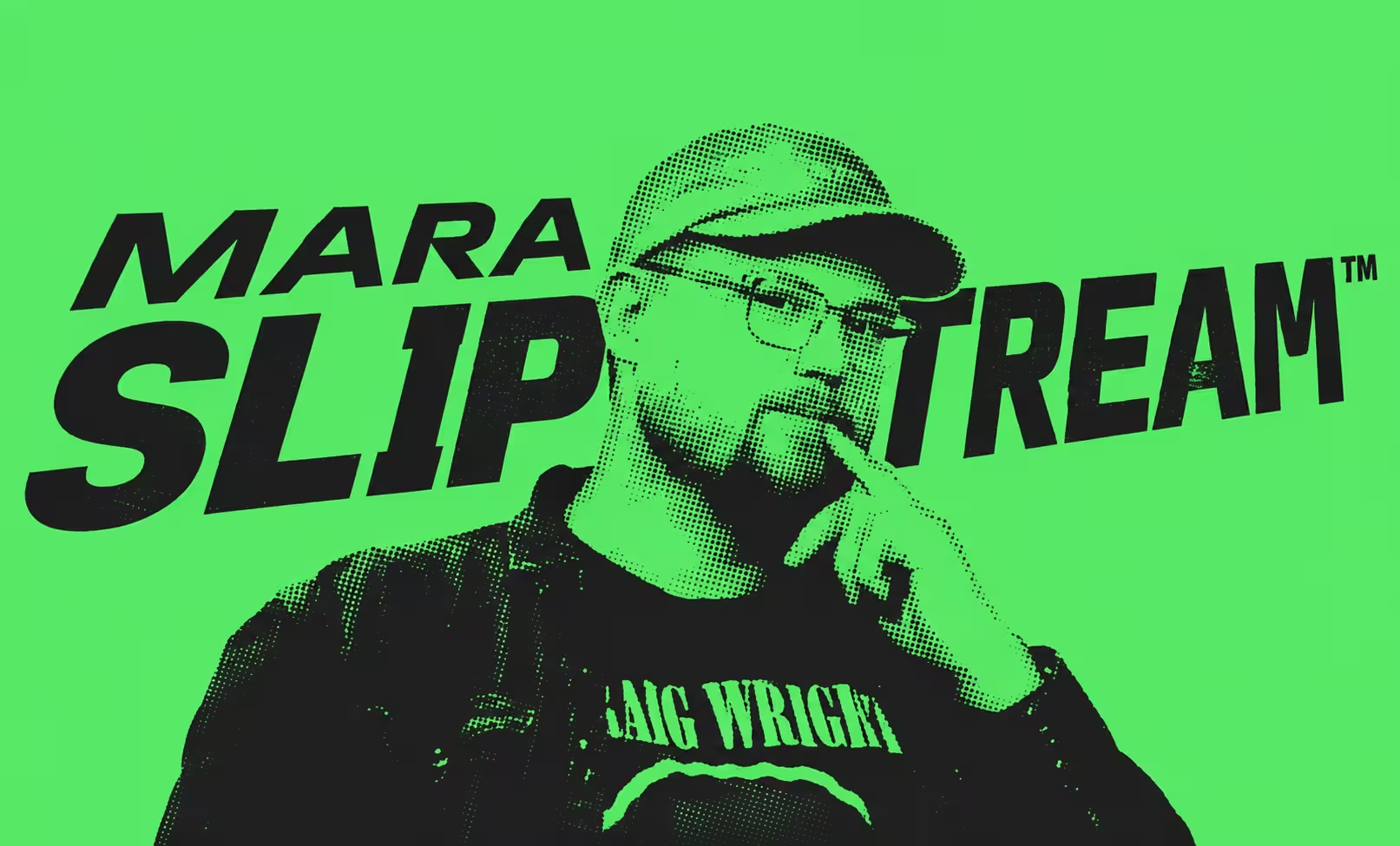
- Prominent Bitcoin developer Peter Todd has joined the MARA Foundation as Lead Maintainer of Slipstream, MARA’s private Bitcoin mempool service.
- Slipstream enables the direct submission of transactions to MARA’s mining pool—enabling R&D use-cases for Bitcoin and helping users move more than 10,000 Bitcoin out of affected Coldcard multisig wallets during the July 2026 exploit of a Coldcard firmware vulnerability.
- Todd supports Slipstream’s use as a proving ground for Bitcoin R&D, including projects like Quantum Safe Bitcoin and Binohash, on top of experimentation for classical and post-quantum security.
Peter Todd, a veteran Bitcoin Core contributor, has joined MARA Foundation as the lead maintainer of Slipstream, MARA’s private mempool service.
Slipstream enables direct submission of Bitcoin transactions to MARA Pool, MARA’s proprietary mining pool.
Slipstream is best known for its use in submission of non-standard Bitcoin transactions (e.g. large inscriptions or non-standard formats like those used in certain BitVM bridging transactions).
Although early high-profile uses included publication of large Ordinals inscriptions in 2024, Slipstream has most recently been used for Bitcoin R&D, such as the development of Quantum Safe Bitcoin and Binohash, a technique for covenant emulation without a soft fork.
Because Slipstream does not broadcast submitted transactions to Bitcoin’s public peer-to-peer network until transactions have been confirmed, Slipstream has implications for Bitcoin security — including classical and post-quantum — or wherever it may be protective to conceal key information prior to block confirmation.
Slipstream generated attention this year for its use during the recent exploit of a Coldcard firmware vulnerability — wherein Coldcard multisig users relied on Slipstream in an effort to reduce exposure of public key material while transactions moved out of affected Coldcard multisig wallets. To date, more than 10,000 Bitcoin has been moved out of affected wallets via Slipstream.
Newly announced Slipstream maintainer Peter Todd previously developed Libre Relay, a Bitcoin implementation with relaxed relay policy rules allowing otherwise non-standard transactions to be relayed to miners. Todd introduced Libre Relay as an open-source Bitcoin Core fork in 2024, amid a boom of experimentation around the Ordinals protocol.
He is also a longtime champion of replace-by-fee (RBF) in Bitcoin Core and co-author of BIP 125, as well as the creator of OpenTimestamps, which uses Bitcoin to prove that data existed prior to a particular point in time.
Todd has been a proponent of “economically rational mempool policy,” aligning what miners will mine with the types of transactions the market demands, rather than constraining how Bitcoin is used with restrictive policies. He also maintains the view that arbitrary data is an inherent, uncensorable feature of permissionless blockchains rather than a bug to be fixed.
“Bitcoin works because information is easy to spread, hard to stifle,”
Todd notes in a recent interview with MARA Foundation’s Isabel Foxen Duke, recalling a statement made by Satoshi Nakamoto in Bitcoin’s infancy on a foundational element of its design.
Referencing Slipstream’s potential for Bitcoin R&D, Todd says,
“I most look forward to seeing what’s possible on Bitcoin — using Slipstream as a proving ground for experimental development and protocol innovation.”
Slipstream submissions remain subject to MARA’s Terms of Service and applicable law.
Read more

Get insights from Bitcoin leaders on governance, mining, security and tech.